



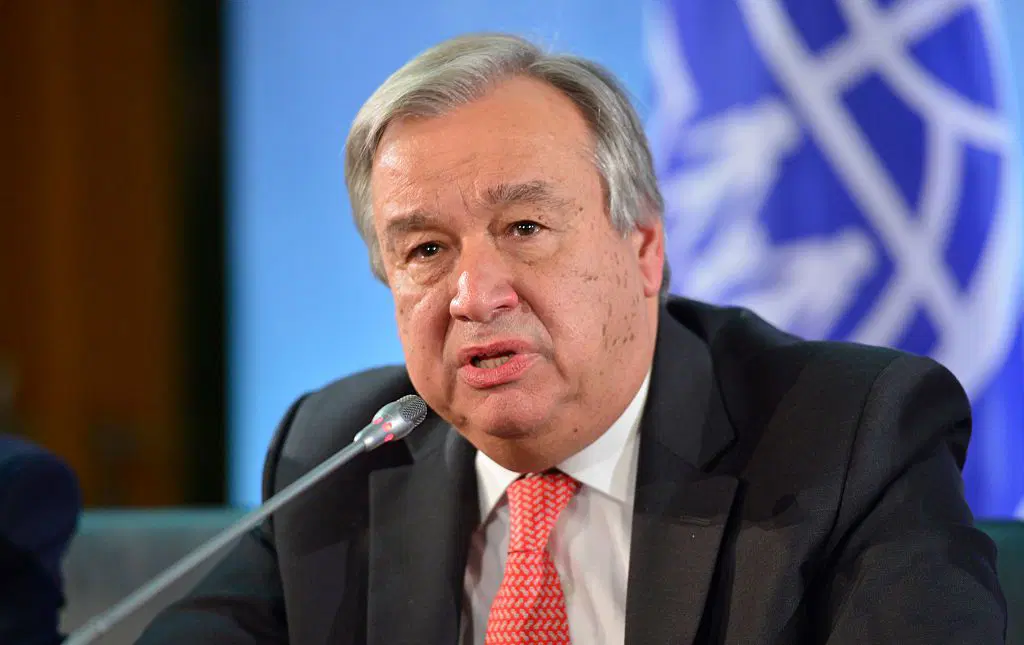
United Nations Secretary-General António Guterres has warned that escalating tensions in the Middle East are pushing the region to the brink, citing attacks on shipping routes, rising oil prices, and a worsening humanitarian crisis.
Guterres made the remarks while speaking in Türkiye during a ceremony where he received the Atatürk International Award for Peace. In his address, he called for an immediate ceasefire and urged all parties involved in the conflict to return to diplomacy.

The UN chief stressed that all actors involved in the conflict must halt hostilities, respect international law, and prioritize the protection of civilians.
“Around the world, we hear much talk of peace, but we see far too little of it,” Guterres said.
He warned that global trends are moving in the wrong direction, pointing to the growing influence of power politics and the weakening respect for international rules.
“International law continues to be trampled, power politics are gaining ground and inequalities are growing,” he said.
Guterres also expressed concern about the role of emerging technologies in modern warfare. According to him, innovations such as artificial intelligence could potentially accelerate violence instead of preventing it.
He further criticized the global surge in military spending, contrasting it with declining resources for humanitarian assistance.
“New technologies, including artificial intelligence, risk accelerating violence rather than preventing it. Military spending is skyrocketing, while lifesaving aid is in freefall,” he noted.
The UN Secretary-General warned that civilians continue to suffer the most as the conflict escalates, with rising death tolls and communities being devastated.
He pointed specifically to the recent wave of military actions involving the United States, Israel, and Iran, saying the developments pose a significant threat to international peace and security.
“The massive military strikes launched by the United States and Israel and the subsequent attacks by Iran on several countries constitute a grave threat to international peace and security and have caused immense suffering for civilians,” Guterres said.
“The region is being pushed to the breaking point.”
Beyond the immediate humanitarian impact, Guterres warned that the crisis is having far-reaching consequences for the global economy and stability.
He highlighted disruptions in international trade routes, rising energy costs, increasing food prices, and broader geopolitical instability.
According to him, the world’s most vulnerable populations are already feeling the harshest effects.
“As always, the most vulnerable are being hurt first and worst,” he said.
Guterres emphasized that the only viable path forward is through de-escalation and renewed diplomatic engagement.
“The region and the world desperately need an off-ramp,” he said, stressing that dialogue remains the only sustainable solution to the crisis.
The UN chief’s visit to Türkiye was part of his annual solidarity trip to a Muslim-majority country during the holy month of Ramadan.
Guterres said the visits serve as a reminder of the core values of Islam, including compassion, community, and empathy.
“These visits are a powerful reminder, to me and to the world, of the true spirit of Islam: compassion, community and empathy,” he said.
“This Ramadan, I felt strongly that my solidarity visit must be here, in Türkiye. I came to shine a global spotlight on the extraordinary and generous spirit of the Turkish people.”
While accepting the Atatürk International Award for Peace, Guterres dedicated the recognition to United Nations staff and humanitarian workers around the world.
He also paid tribute to aid workers who have lost their lives while delivering assistance in conflict zones.
“Together, let us give peace a chance,” the UN Secretary-General concluded.




Related posts:
 Uncertainty Surrounds Iran’s Leadership as Succession Plans Emerge After Khamenei’s Death
 Mojtaba Khamenei Named Iran’s New Supreme Leader After Father’s Death
 Iran’s New Supreme Leader Reportedly Wounded Amid Escalating Middle East Conflict
 Iran’s New Supreme Leader Reportedly In A Coma After Losing A Leg
 Australia Withdraws Non-Essential Officials from Israel and UAE Over Security Concerns
 US Refuelling Aircraft Crashes in Iraq Amid Escalating Iran Conflict