



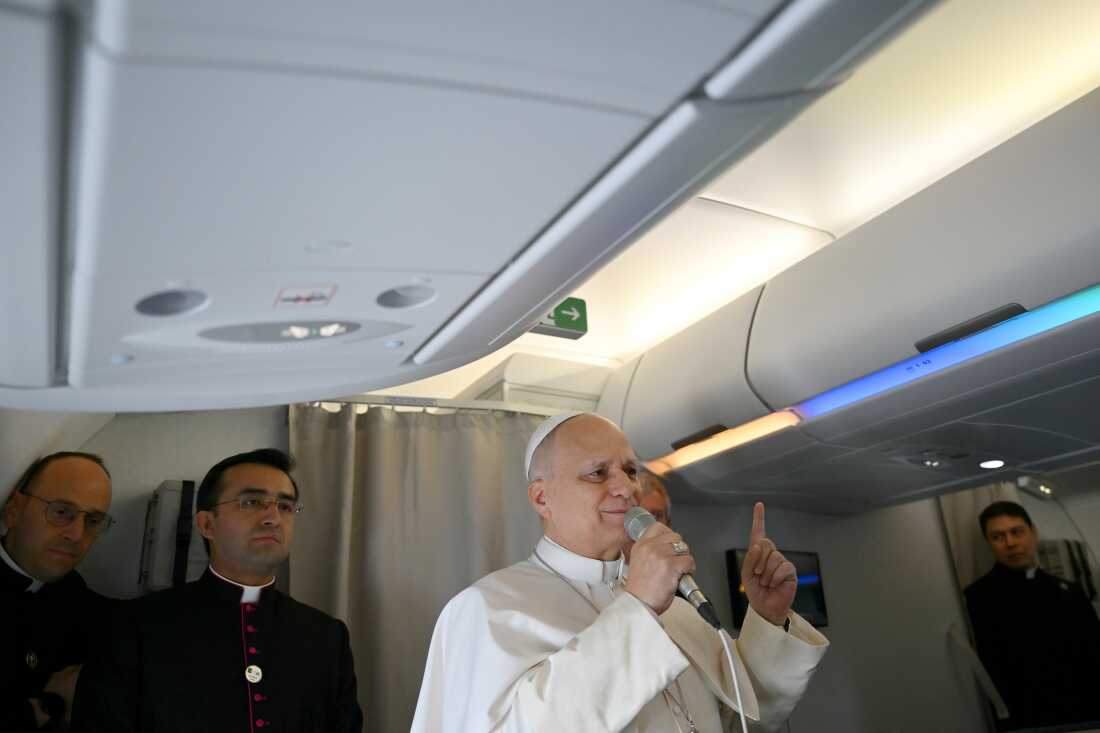
Tensions between religious and political leadership came into sharp focus this week as Pope Leo responded to criticism from Donald Trump, reaffirming his commitment to speaking out against global conflict.
The exchange follows remarks by Trump, who described the pontiff as “weak” and “terrible for foreign policy” after the pope voiced opposition to the ongoing war involving Iran.

Speaking to journalists aboard a papal flight en route to Algiers, where he is set to begin a 10-day tour across Africa, Pope Leo made it clear he would not be drawn into a personal feud.
“I don’t want to get into a debate with him,” the pope said. “I don’t think that the message of the Gospel is meant to be abused in the way that some people are doing.”
Despite the criticism, he emphasized that his mission remains rooted in promoting peace rather than engaging in political disputes.
“I’m not afraid of the Trump administration or of speaking out loudly about the message of the Gospel,” he added.
The Chicago-born pontiff drew a distinction between religious leadership and political governance, stressing that the Church’s role is not to shape foreign policy but to advocate for moral principles.
“We are not politicians. We do not look at foreign policy from the same perspective,” he explained.
Instead, Pope Leo reiterated his commitment to encouraging dialogue, multilateral cooperation, and peaceful conflict resolution.
In recent weeks, the pope has become increasingly vocal about the human cost of war, particularly amid escalating tensions involving Iran. Over the weekend, he condemned what he described as the “madness of war” and called for renewed efforts toward peace.
“Too many people are suffering in the world today. Too many innocent people are being killed,” he said. “Someone has to stand up and say there’s a better way.”
At the heart of his message is a core Christian teaching:
“Blessed are the peacemakers.”
Trump’s remarks, posted on Truth Social, appear to reflect broader disagreements not only over the conflict but also over issues like immigration policy areas where the pope has also expressed concern.
The public exchange highlights an ongoing tension between moral advocacy from religious leaders and the strategic priorities of political figures.
While the rhetoric between the two figures may continue to draw attention, Pope Leo’s stance remains consistent: his role is not to engage in political battles, but to amplify a message of peace in a world increasingly marked by conflict.
As global tensions persist, his voice adds to a growing chorus calling for diplomacy over division and dialogue over war.




Related posts:
 Trump Criticises UK Over Iran Stance as Fuel Crisis Deepens
 Iran’s New Supreme Leader Reportedly Wounded Amid Escalating Middle East Conflict
 Australia Withdraws Non-Essential Officials from Israel and UAE Over Security Concerns
 Trump Says He Warned Netanyahu Against Striking Iranian Gas Facilities
 U.S. Man Arrested Over Alleged Threats to Kill President Donald Trump
 Trump Speaks on His Rage With NATO and the Greenland