



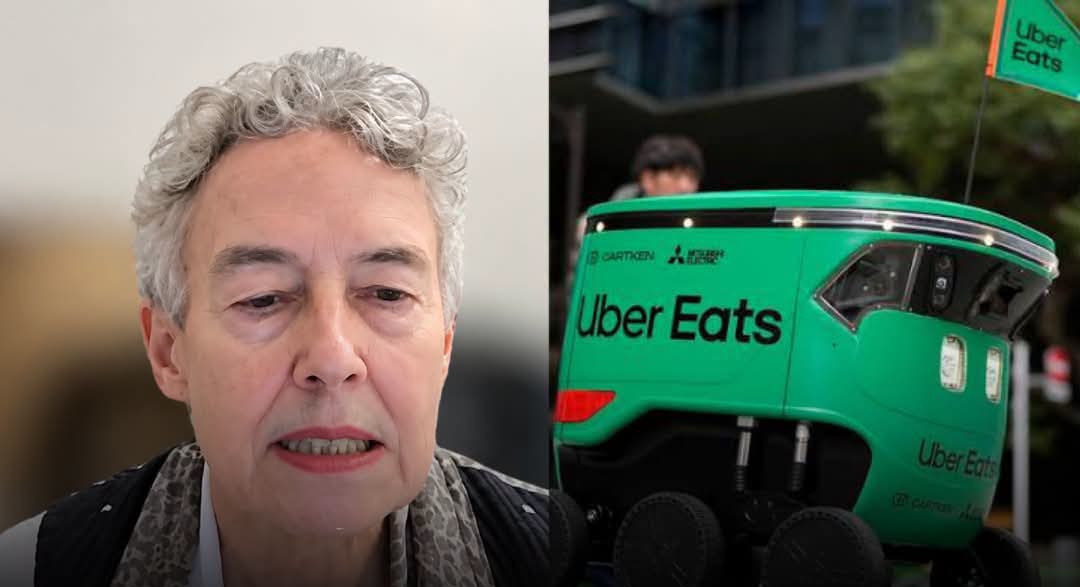
A 78-year-old retired University of Pennsylvania professor, Carolyn Marvin, has been arrested in Philadelphia, the United States, for allegedly obstructing an Uber Eats delivery robot during a protest against automation and the loss of human jobs.
Marvin was reportedly taken into custody on Wednesday after refusing to move out of the autonomous robot’s path despite repeated requests from police, according to PhillyVoice.

She was subsequently charged with disorderly conduct.
The retired professor, who previously taught a course on freedom of expression at the University of Pennsylvania, said she had been confronting delivery robots for months because she believes companies are increasingly relying on machines at the expense of human workers.
Marvin argued that businesses were adopting the technology primarily to cut costs and increase profits.
“I know they’re taking the jobs of human delivery workers and, so, I have been protesting them whenever I saw them by standing in front of them and preventing them from going forward,” she said.
Despite her arrest, Marvin said she had no intention of abandoning her campaign, insisting that she would challenge the charge.
Speaking to WPVI-TV, she argued that her actions were protected by the United States Constitution’s First Amendment, which guarantees freedom of speech and peaceful assembly, among other rights.
“I think it’s my First Amendment right to publicly demonstrate on a sidewalk to protest against delivery robots,” she said.
Explaining her motivation, she added: “I’m exercising the rights of my citizenship, so I think of it in those terms.”
Her actions have sparked mixed reactions on social media, with some users praising her determination to defend human workers, while others questioned her decision to obstruct the machines.
One supporter described her as a hero, writing, “Some heroines don’t wear capes.” Another user went further, suggesting that she should have destroyed the robot.
However, critics argued that blocking delivery robots was not an appropriate way to protest. One commenter pointed out that such machines could be transporting essential items, including medicine, while another dismissed Marvin as a “Robotic Karen”.
The incident has renewed debate about the growing use of autonomous technology in everyday services and its potential impact on employment.
For Marvin, however, the arrest appears unlikely to end her protest. She has maintained that she will continue confronting delivery robots when she encounters them, hoping to draw greater attention to the implications of automation for human workers.




Related posts:
 Oyo Teachers Begin Indefinite Strike Over Abducted Colleagues and Pupils
 ‘Protests Could Complicate Rescue Efforts’ – Makinde Appeals to Families of Kidnapped Pupils
 Osun Guber: Women Storm Osogbo Streets, Protest Violence, Intimidation
 BREAKING: Uber Exits Nigeria After 12 Years, Winds Down Operations Nationwide
 Uber Left Nigeria Because It Couldn’t Compete With Improved Infrastructure — Reno Omokri
 Protest Rocks Spain As Housing Crisis Escalates