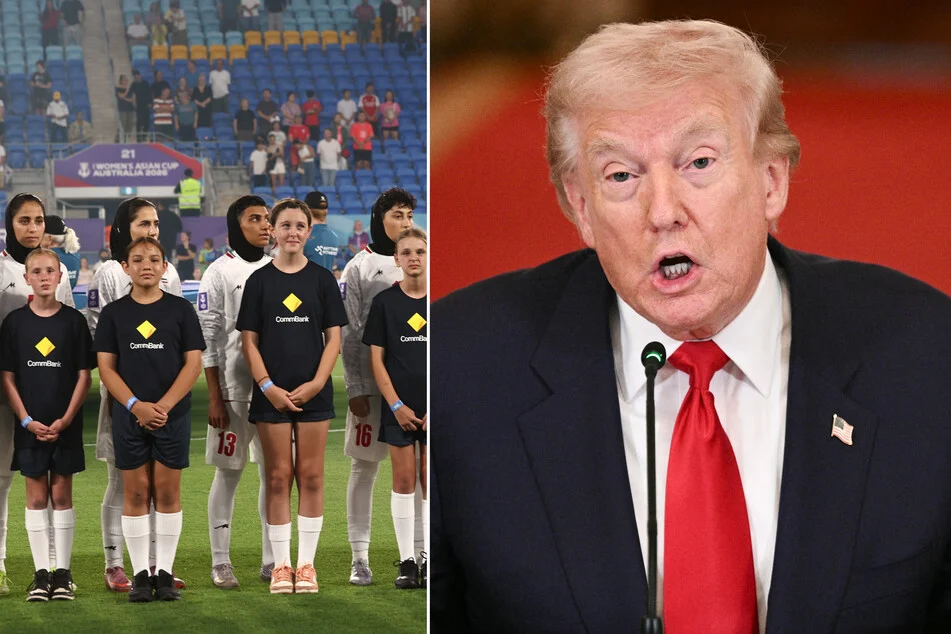
US President Donald Trump has called on the Australian government to grant asylum to members of the Iran women’s national football team amid fears they could face persecution if they return home.
Concerns grew after the team was eliminated from the AFC Women’s Asian Cup on Sunday following a 2–0 defeat to the Philippines women’s national football team in Gold Coast, Australia. Iranian media reportedly labelled the players “traitors” after they refused to sing the national anthem before their opening match, an act seen by critics as a protest against the Iranian regime during the ongoing conflict in the Middle East.

Reports also claimed that one of the Iranian players made the international SOS distress signal while inside the team bus after the defeat. The gesture involves tucking the thumb into the palm and folding the fingers over it — a recognised signal indicating someone is seeking help.
Writing on the social media platform Truth Social, Trump urged Anthony Albanese, Australia’s prime minister, to intervene.
“Australia is making a terrible humanitarian mistake by allowing the Iranian Women’s National Soccer team to be forced back to Iran, where they will most likely be killed,” Trump wrote.
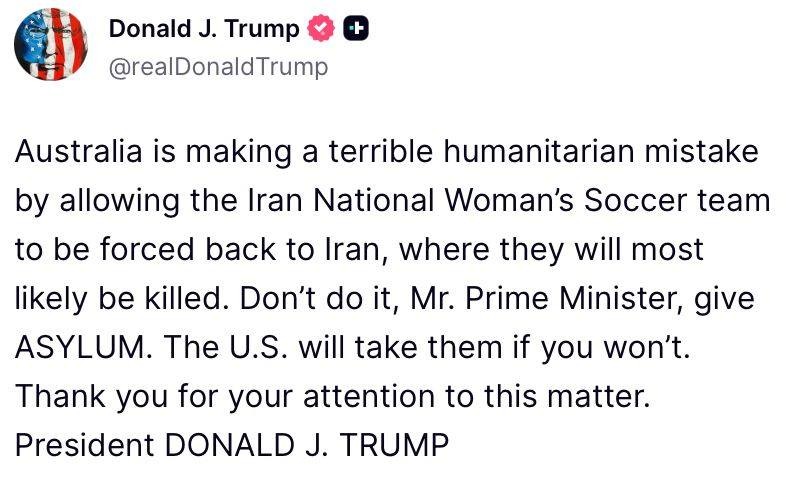
“Don’t do it, Mr Prime Minister — give asylum. The US will take them if you won’t. Thank you for your attention to this matter. President Donald J. Trump.”
Football’s global governing body FIFA said on Monday it was in “close contact” with Australian authorities regarding the situation, stressing that the safety and security of the players remained its top priority.
Although the Iranian players later sang the national anthem and saluted the flag before their final two matches, their earlier refusal drew strong criticism from supporters of the Iranian government.
Speaking at the general assembly of the players’ union in Sydney on Sunday, Beau Busch, president of FIFPRO for Asia/Oceania, said the union had been unable to establish contact with the Iranian squad. He added that it was essential for FIFA, the Asian Football Confederation and the Australian government to ensure the players retained control over their future.
“We’ve been asking the Australian government to work on the players having agency,” Busch said. “It’s a really challenging situation. There may be players who want to return. There may be some who would like to seek asylum or stay in Australia longer. Others may be deeply concerned about the journey home.”
The situation has unfolded amid escalating regional tensions following air strikes by the United States and Israel on Iran. Iran has since launched retaliatory attacks against Gulf states hosting US military bases, including Saudi Arabia, the United Arab Emirates and Bahrain.
The wider instability has also created travel and administrative challenges across the region, raising uncertainty over Iraq’s planned FIFA World Cup play-off match in Mexico scheduled for 31 March.
Iraq’s head coach, Graham Arnold, has suggested staging the match against either Bolivia or Suriname earlier than planned, with the winning side remaining in North America ahead of the finals in June.
Speaking to the Australian Associated Press, Arnold said the adjustment could also provide more time to determine whether Iran would participate in the World Cup. He added that if Iran withdrew, Iraq could potentially take their place, with the United Arab Emirates moving into the play-off position.