



By Emmanuella Peters
From Osun’s first civilian governor to a billionaire businessman and one of Africa’s biggest Afrobeats stars, the story of the Adeleke family is also the story of a remarkable Nigerian matriarch

There are family names that appear repeatedly in Nigeria’s political history. There are others that dominate business, education or entertainment.
Then there is the Adeleke name a family whose influence cuts across all four.
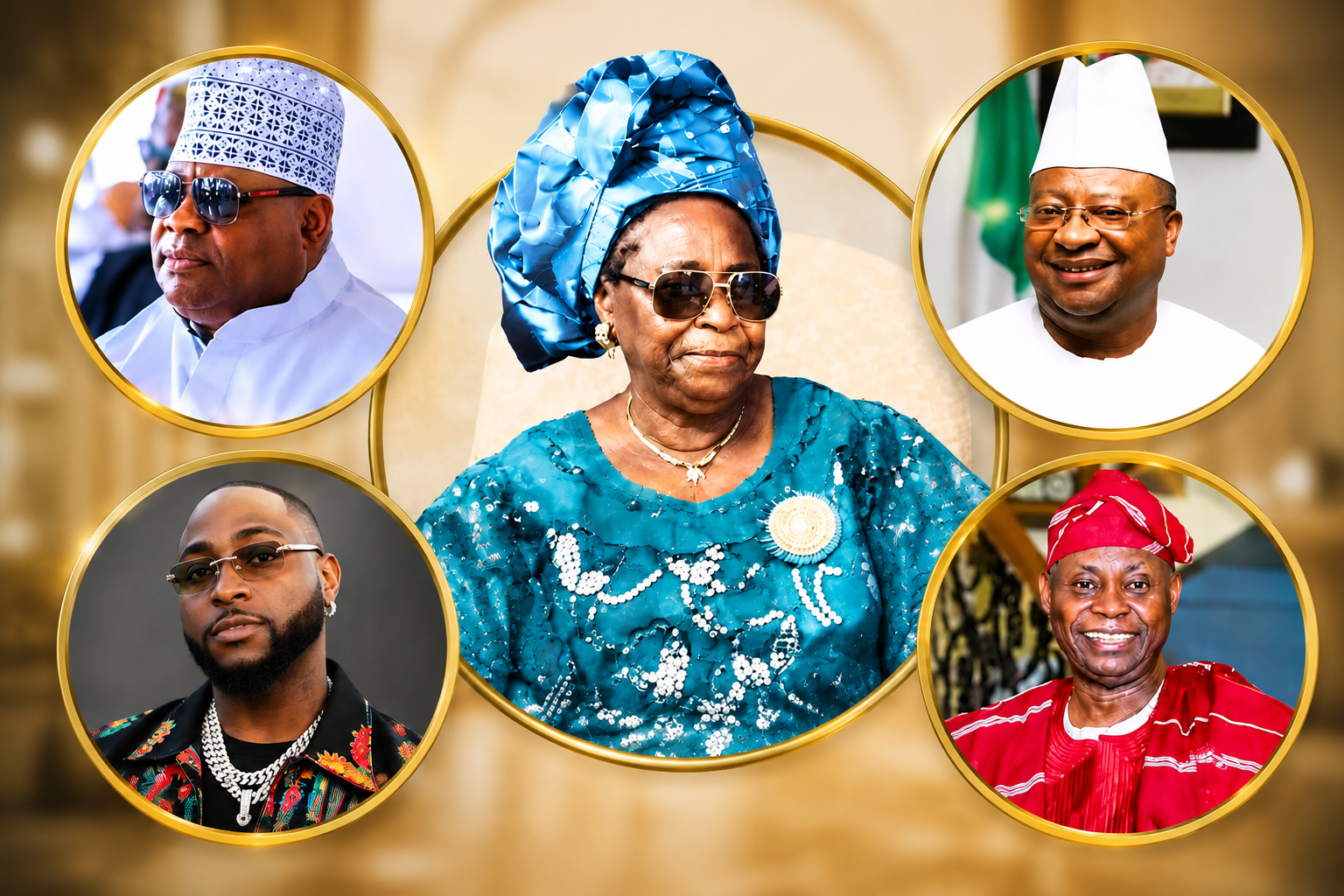
At the heart of that remarkable story is Mrs Nnenna Esther Adeleke, née Akparah, an Igbo woman from Akwete in Ukwa East Local Government Area of Abia State, whose marriage to the prominent Ede politician, Senator Raji Ayoola Adeleke, brought together two cultures and produced children who would go on to occupy very different but influential spaces in Nigerian public life.
Her story is often overshadowed by the fame of her children and grandson.
Yet, without her, there would be no Adeleke political dynasty as Nigerians know it today.
Her sons included Senator Isiaka Adetunji Adeleke, the first elected civilian governor of Osun State; Senator Ademola Adeleke, who later became governor of the same state; and Dr Adedeji Tajudeen Adeleke, a businessman, philanthropist, educationist and founder of Adeleke University.
Adedeji, in turn, became the father of David Adeleke, popularly known as Davido, the globally celebrated Afrobeats superstar.
It is an extraordinary family tree.
One son made history in Osun politics. Another followed him into the same Government House decades later. A third built a substantial business and educational empire, while his son became one of Africa’s most recognisable entertainers.
And behind much of that story was a woman whose own heritage reflected the diversity of Nigeria.
A marriage that brought two worlds together
Nnenna Esther Adeleke was born into an Igbo family in Abia State before marrying into the Adeleke family of Ede, Osun State.
The union between Nnenna and Raji Ayoola Adeleke represented the coming together of two major Nigerian cultural traditions — Igbo and Yoruba.
Adeleke University, established by her son Adedeji, has itself highlighted the marriage of Raji Ayoola Adeleke and Esther Nnenna Adeleke as an example of cultural and religious diversity: he was a Yoruba Muslim, while she was an Igbo Christian.
Their children inherited that multicultural background.
Adedeji, for instance, was born in Enugu in 1957 and spent part of his early childhood in the former Eastern Region before moving to Lagos and later Ede. He went on to study Finance at Western Kentucky University, where he obtained his bachelor’s degree in 1979 and an MBA in 1981. He later earned a PhD in International Business.
The family story therefore began long before politics and celebrity.
It began with a home where different cultures, faiths and traditions met.
Isiaka: the first Adeleke governor
The first major political chapter of the family was written by Isiaka Adetunji Adeleke.
When Osun State was created from the old Oyo State in August 1991, the state was initially administered by a military governor. But in 1992, Isiaka Adeleke made history by becoming its first democratically elected civilian governor.
He was only about 37 years old.
He served from January 1992 until November 1993, when the military takeover brought the short-lived Third Republic to an end. The Osun State Government describes him as the state’s first civilian governor and credits his administration with laying an important foundation for the young state.
His administration was brief, but it was not insignificant.
Among the projects associated with his government were the establishment of the Osun State Polytechnic, Iree, a college of technology at Esa-Oke and the completion of the Osun State Broadcasting Corporation.
Adeleke later returned to national politics, serving in the Senate representing Osun West.
He won the seat in 2007 under the Peoples Democratic Party and returned to the Senate in 2015 on the platform of the All Progressives Congress.
He died in April 2017 at the age of 62.
For the Adeleke family, however, his death did not mark the end of the political journey.
It opened the way for another brother to step into the spotlight.
Ademola: the dancing senator who became governor
Ademola Adeleke did not immediately look like the conventional Nigerian politician.
He was expressive, flamboyant and famously fond of dancing.
His political opponents mocked him for it. His supporters embraced it.
Eventually, the dancing became part of his political identity.
But behind the viral videos was a politician determined to return to the race after coming close in 2018.
In the 2022 Osun governorship election, Adeleke defeated the incumbent, Gboyega Oyetola of the APC, securing 403,371 votes against Oyetola’s 375,027.
He was sworn in as the sixth elected governor of Osun State on November 27, 2022.
With that victory, the Adeleke family achieved something highly unusual in Nigerian political history: two brothers had served as elected governors of the same state at different times.
Isiaka had governed Osun in the early 1990s.
Ademola returned the Adeleke name to the Osun Government House almost three decades later.
It was not simply another election victory.
It was the revival of a political legacy.
Ademola himself has repeatedly acknowledged the influence of his late brother, describing Isiaka as a leader who laid a foundation for the young state. In 2024, he unveiled a memorial circle and park dedicated to the former governor.
The businessman who built another pillar of the dynasty
While Isiaka and Ademola pursued politics, their brother Adedeji Adeleke built his own influence away from the political stage.
Adeleke became a prominent businessman and philanthropist and established Pacific Holdings, with interests including power generation and other investments.
He also became the pioneer Pro-Chancellor of Adeleke University, which received Federal Government approval in March 2011.
His academic and philanthropic record is substantial.
Adeleke established the Springtime Development Foundation in 1996 to support disadvantaged Nigerians through education. He has also been associated with scholarship programmes that have supported thousands of students.
But his most significant business footprint in recent years has been in Nigeria’s electricity sector.
The 55 per cent claim that needs correcting
The claim that Pacific Holdings contributes more than 55 per cent of Nigeria’s power generation is widely repeated online, but it should not be presented as fact without qualification.
Adeleke himself said in 2024 that his company was generating about 15 per cent of the electricity produced for Nigeria.
That is still a sizeable contribution in a country where unreliable electricity supply has remained one of the biggest constraints on economic growth.
His company has also invested heavily in thermal power generation.
In 2024, Adeleke said he was developing a 1,250-megawatt gas-fired power plant, estimated at $2bn, which he described as potentially the biggest thermal power plant in Nigeria.
Reports later put the completed plant’s installed capacity at 1,250MW, although it was awaiting connection to the national gas grid before beginning full operations.
The figures provide an important perspective on the economic side of the Adeleke story.
The family’s influence is not based on politics alone.
There is a business infrastructure behind it.
There is also an educational institution carrying the family name.
And then there is Davido.
From the Adeleke family to the global stage
Few members of the family have transformed the Adeleke name as dramatically as David Adeleke, better known around the world as Davido.
The musician inherited more than a famous surname.
He grew up in a family with considerable financial resources, but built a career that eventually established him as one of Africa’s biggest music stars.
His success has given the Adeleke name a reach that traditional political machinery could hardly buy.
Davido has performed around the world, built a massive digital following and become one of the most commercially successful Nigerian artistes of his generation.
His influence has also increasingly intersected with politics.
When his uncle was inaugurated as governor of Osun in 2022, Davido was among those present, walking into the venue alongside Ademola Adeleke and attracting considerable public attention.
That image captured something unusual about the modern Adeleke dynasty.
The politician was on the stage.
The billionaire businessman was in the family background.
And the global pop star was standing beside him.
Davido’s effect on the Adeleke political brand
Davido’s importance to the family extends beyond his music.
He represents access to a younger Nigeria.
The average Nigerian politician may struggle to get the attention of millions of young people online. Davido can command that attention with a single post, appearance or campaign message.
That does not automatically translate into votes.
But it creates something valuable in modern politics: visibility.
The Adeleke political brand has consequently benefited from a rare combination of grassroots political structures and celebrity appeal.
Ademola’s dancing has made him highly recognisable.
Davido’s music has made the family name globally recognisable.
Adedeji’s wealth has given the family economic visibility.
Isiaka’s legacy provides historical depth.
Together, these elements make the Adelekes unusually prominent in Nigeria’s political and social landscape.
Could Davido be the next Adeleke governor?
That question is increasingly difficult to ignore.
Davido has not publicly declared an ambition to become governor of Osun State, and there is no basis for presenting a future governorship bid as a settled plan.
But the speculation is understandable.
He already possesses several ingredients that aspiring politicians spend years building: name recognition, a large following, financial resources, celebrity status and an established political family.
More importantly, he understands the power of youth culture.
A future Davido political campaign would not look like a traditional Nigerian campaign.
It would almost certainly be driven heavily by social media, entertainment, youth mobilisation and his enormous personal brand.
Yet fame alone cannot govern a state.
If Davido ever enters politics, he would have to make the difficult transition from entertainer to policymaker from winning applause to winning public confidence, building political coalitions and demonstrating competence in governance.
That would be an entirely different arena.
For now, his strongest political value to the Adeleke family may simply be his ability to amplify its message and connect it with a generation that traditional politicians often struggle to reach.
More than a political dynasty
It is tempting to describe the Adelekes simply as a political dynasty.
That would, however, tell only half the story.
The family has built influence across politics, business, education and entertainment.
Isiaka gave the family its first major political landmark.
Ademola revived that political legacy.
Adedeji created an economic and educational pillar.
Davido turned the family name into an international cultural brand.
And behind the brothers was Nnenna Esther Adeleke.
Her life may not have generated the headlines that followed her children and grandson, but her legacy is visible in all of them.
She came from Akwete in present-day Abia State and married into a prominent Yoruba political family in Ede.
Her children went on to occupy spaces that few Nigerian families can claim simultaneously.
One became Osun’s first elected civilian governor.
Another became governor of the same state.
One became a major businessman, philanthropist and educationist.
His son became an international music superstar.
That is why the Adeleke story is bigger than one election, one governor or one musician.
It is a story about how family, identity, ambition, wealth, politics and popular culture can intersect in modern Nigeria.
A legacy still being written
The most remarkable thing about the Adeleke family may be that its story is not finished.
The political chapter continues with Ademola.
The business and education chapters continue through Adedeji’s institutions and investments.
And Davido remains one of the family’s most powerful public faces.
Whether another Adeleke will eventually occupy Osun Government House remains a question for the future.
For now, history has already recorded something extraordinary.
A woman from Akwete became the mother of two elected governors of the same Nigerian state at different times, while another of her sons built a major business and educational career and became the father of one of Africa’s biggest music stars.
The Adeleke name now carries political history, business influence and cultural power in equal measure.
And perhaps that is the real legacy of Nnenna Esther Adeleke.
She did not simply raise children who became successful.
She raised a family whose influence crossed generations from the political history of Osun to the boardrooms of Nigerian business and, eventually, to the world’s biggest music stages.
The dynasty is not merely remembered. It is still being written.




Related posts:
 Adeleke, Accord Party Drums Support for Tinubu’s 2027 Re-Election Bid
 Bill Gates Says He Didn’t Witness Crimes But May Have Been in Presence of Epstein Victims
 MINISTERS OF FOREIGN AFFAIRS, AVIATION TO HOST THIRD EDITION OF THE EXPATRIATES BUSINESS AWARDS IN ABUJA
 Osun Election: Prepare to Sign Your Uncle as a Dancer in Your Music – Uzodimma Replies Davido
‘You’re Broke’ – Davido Reportedly Shades Iyabo Ojo’s Partner, Paulo, Over Afrobeat Remarks
 Osun Election: Adeleke Wins 19 LGAs, Leads Oyebamiji