



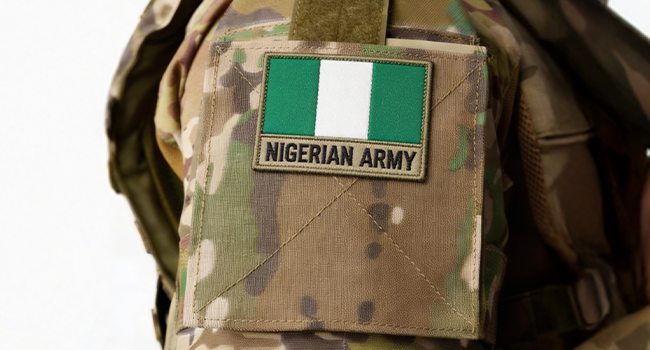
A former Commander of Operation Safe Haven, Henry Ayoola (rtd), has dismissed claims that Nigerian soldiers purchasing personal military equipment is evidence of systemic failure within the Armed Forces.
His remarks follow a viral interview by ex-soldier Rotimi Olamilekan, popularly known as “Soja Boi,” who alleged that personnel are often forced to buy essential items such as uniforms, boots, and bulletproof vests due to inadequate welfare and low pay.

Speaking in an interview on Channels Television on April 10, Ayoola argued that the practice of soldiers supplementing issued gear with personal purchases does not necessarily indicate institutional breakdown.
According to him, the Nigerian military maintains a standard provision system for equipment, and what some personnel acquire independently is often an enhancement rather than a replacement of official issue.
“The idea of a soldier, out of personal choice, spending money to improve their kit beyond the standard issue should not be a big deal. It does not mean the system is not working,” he said. He added that the Armed Forces already provide a defined baseline known as a “full-service matching order.”
Ayoola stressed that every soldier is entitled to a minimum standard of kit, insisting that claims suggesting a total absence of official provision are inaccurate.
“There is a minimum standard of kit that every soldier must be given. It is not true to say that authorities are not kitting soldiers,” he explained.
The retired commander also acknowledged that operational constraints can sometimes affect logistics and supply chains, leading field commanders to adapt to available resources.
“When equipment is limited, it is rationalised. There is innovation, and sometimes troops make do with what is available,” he said.
His comments come amid renewed public scrutiny of military welfare conditions, sparked by testimonies from serving and former personnel, and ongoing debates about resource allocation within security agencies.
While concerns about troop welfare continue to surface, Ayoola maintained that operational realities often require flexibility rather than being interpreted as systemic failure.




Related posts:
 BREAKING: CAF reschedules 2026 Women’s Africa Cup of Nations to July–August in Morocco
 Actress Sarah Martins Apologizes After Lagos Government Criticism Over Street Cooking
 Police Seal Off Venue for ADC Committee Inauguration in Calabar
 Air Force Officer Arrested After Shooting Civilian Dead in Port Harcourt
 Igbinedion School Bullying Suspects Arrested, to be Charged as Juveniles in Court