



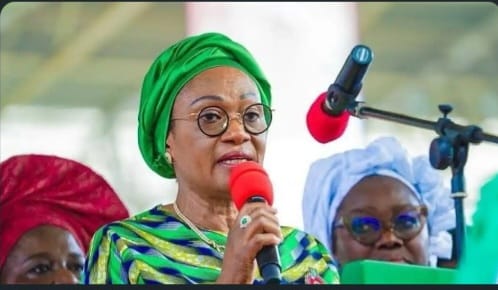
Nigeria’s First Lady, Oluremi Tinubu, has announced a N2bn Learners Retention Support Programme targeting 100,000 pupils in its first phase, as the Federal Government steps up efforts to keep children in school.
Under the programme, each beneficiary is expected to receive N20,000 to help ease financial difficulties that prevent children from attending school regularly or completing their education.

Mrs Tinubu announced the initiative on Monday at the national flag-off of the distribution of two million packs of sanitary towels and back-to-school learning materials to girls in public basic education schools across the 36 states and the Federal Capital Territory (FCT).
The event, held at the State House Conference Centre in Abuja, was organised to commemorate the 2026 International Day of the Girl Child.
The First Lady also flagged off the distribution of the materials under the Flow with Confidence 2.0 initiative, which seeks to address menstrual hygiene challenges that force many girls, particularly those in rural communities, to miss school.
She said no Nigerian girl should lose access to education or be prevented from reaching her full potential because of menstruation or her family’s inability to afford basic school supplies.
“Keeping our girls in school requires us to recognise and address the challenges that affect their education, especially those in rural communities, who often miss school because they do not have access to sanitary products,” she said.
The initiative builds on the first Flow with Confidence programme launched by the First Lady’s Renewed Hope Initiative on October 2, 2025. The earlier intervention provided a year’s supply of disposable sanitary pads to 370,000 schoolgirls in rural communities across the country.
Mrs Tinubu welcomed the Universal Basic Education Commission’s (UBEC) decision to adopt and expand the programme, noting that providing sanitary towels alongside learning materials would help girls attend school with confidence and dignity.
She urged governors’ wives, commissioners for education and chairmen of State Universal Basic Education Boards to ensure that the items reached the intended beneficiaries through a transparent and accountable distribution process.
The First Lady also called on traditional rulers, religious leaders and community stakeholders to challenge the stigma surrounding menstruation and encourage families to prioritise girls’ education.
Addressing the beneficiaries, she encouraged them to remain focused on their aspirations and seek support whenever they encountered difficulties.
“To our beloved girls across Nigeria, I encourage you to believe in your dreams, stay in school, work hard, and speak up when you need help,” she said.
“I want you to grow into confident and courageous women ready to contribute meaningfully to our nation. Nigeria is counting on you, and I believe in you.”
FG Moves to Sustain Menstrual Hygiene Support
The Minister of Education, Dr Tunji Alausa, said the Federal Government was working to make menstrual hygiene support a regular feature of its basic education interventions.
He recalled pledging to institutionalise the programme through UBEC and the World Bank-supported Adolescent Girls Initiative for Learning and Empowerment (AGILE) when Mrs Tinubu launched the first phase in 2025.
According to him, UBEC will make annual budgetary provisions for the supply of sanitary towels, while AGILE will sustain the intervention throughout the duration of its project.
“Today, we are translating that pledge into practical action. UBEC will make provision within its annual budgets to support the supply of sanitary towels to girls in public basic education schools,” Alausa said.
The minister added that the initial target of reaching 370,000 adolescent girls had been achieved, describing the latest distribution as an opportunity to extend the support to more schoolgirls nationwide.
The Minister of State for Education, Prof Suwaiba Ahmad, said the initiative demonstrated the government’s commitment to protecting the dignity of the girl child and ensuring that menstruation did not disrupt learning.
She urged girls not to allow personal or financial challenges to limit their ambitions, assuring them that the government was working to provide the support and opportunities they needed to succeed.
UBEC Lists Learning Materials, School Infrastructure Efforts
In her welcome address, UBEC Executive Secretary, Aisha Garba, said practical interventions could help remove barriers that prevent girls from pursuing their educational ambitions.
She illustrated the challenge with the example of a rural schoolgirl who dreams of becoming a teacher, doctor, engineer or lawyer but is unable to attend school because her family cannot afford sanitary towels.
“Sometimes, the key that unlocks that remarkable future is something as simple as a sanitary towel,” Garba said.
She disclosed that the two million packs of sanitary towels would be distributed alongside school bags, shoes, exercise books, mathematical sets and writing materials to girls in public basic education schools across the country.
Garba also said UBEC had constructed more than 4,000 classrooms in less than three years, distributed learning materials to over three million pupils and facilitated the return of more than 700,000 out-of-school children to the classroom.
The Chairman of the UBEC Governing Board, Tanko Al-Makura, said the intervention was also intended to reduce school dropouts and protect girls from the risks associated with early marriage.
He noted that girls from financially disadvantaged households were often the first to lose access to education when their families experienced economic hardship.
“Child marriage and dropping out of school are two sides of the same coin,” Al-Makura said.
“A girl rarely leaves school on the day she is married. She leaves weeks and months before, one missed day at a time, until there is nothing left to hold her.”
He pledged the board’s support for monitoring the distribution exercise to ensure that the materials reached the intended beneficiaries.
Sultan, UK Back Stronger Protection for Girls
The Sultan of Sokoto, Alhaji Sa’ad Abubakar, represented by the Emir of Argungu, Samaila Mera, said menstruation should never become an obstacle to education.
He urged traditional rulers, religious leaders, parents, teachers and other community stakeholders to challenge harmful misconceptions and practices that deprive children of educational opportunities.
The monarch also called for a transparent and equitable distribution process, stressing the need for the initiative to deliver lasting improvements in girls’ school attendance and retention.
In a goodwill message, the Education Lead at the British High Commission, Ian Attfield, said investment in girls’ education produced significant economic and social benefits.
He noted that each additional year of schooling increased women’s earnings by an average of 12 per cent.
Attfield added that UK-supported programmes had helped more than 1.5 million additional girls gain access to education in northern Nigeria since 2012.
He called for sustained efforts to tackle child marriage, improve access to education and healthcare, and strengthen safeguards against gender-based violence and abuse.
He also highlighted the $1.2bn AGILE programme, which is expanding access to secondary education for girls in 21 states while promoting empowerment and opportunities in science, technology, engineering and mathematics.
The ceremony featured a stage play titled Daughters of the Nation, which highlighted the challenges facing girls and the need to protect their rights, dignity and access to education.




Related posts:
 FG Introduces Learner ID to Track Pupils, Tackle Dropout Crisis
 Ayodele Criticises Remi Tinubu Over Response to Abducted Oyo Schoolchildren
 The First Lady Remi Tinubu Has No Place in the Presidency; She Should Focus on Kitchen Duties — Warri High Chief
 Atiku Criticises Tinubu Administration Over Response to Abducted Oyo Schoolchildren
 11-Year-Old Boy Allegedly Forcibly Circumcised by Four Pupils in South Africa
 ‘I Want to Enjoy Nigeria at Old Age’ — Remi Tinubu Seeks Support for Husband’s Re-election