



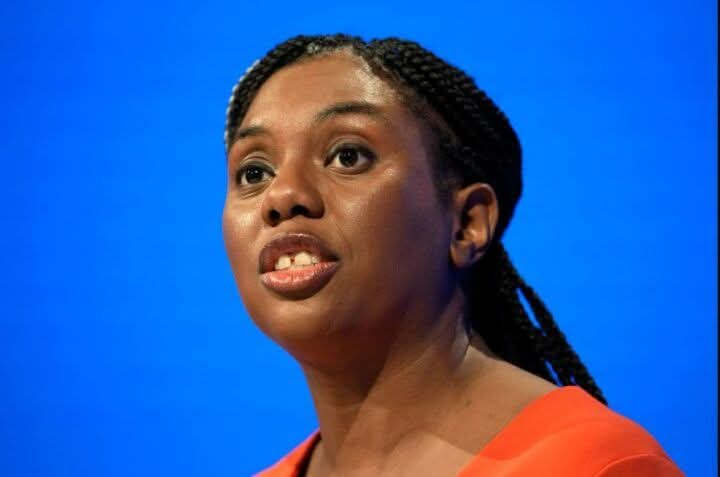
The leader of the UK Conservative Party, Kemi Badenoch, has criticised Nigeria’s governance record, arguing that decades of poor public policy have prevented the country from fully benefiting from its vast natural resources.
Speaking about how her upbringing in Nigeria shaped her political outlook, Badenoch said the country’s persistent electricity crisis was a stark example of policy failures despite its status as one of Africa’s leading oil-producing nations.

“Nigeria is an oil-producing country that has never had electricity,” she said. “It is very easy to have resources under the ground, but stupid public policy means that you can’t use them.”
The British politician said her experiences growing up in Nigeria continue to influence her views on government intervention, economic management and national development.
Drawing comparisons between some policies being pursued in the United Kingdom and the approach adopted by past Nigerian military regimes, Badenoch criticised what she described as excessive state control over the economy.
“And I see quite a lot of what Ed Miliband is doing as being very much like what the Nigerian military dictatorships were doing in the 1980s and 1990s,” she said.
According to Badenoch, policies centred on government control and wealth redistribution often fail to create long-term prosperity and can weaken economic growth.
“The government’s going to take control. We know what’s best. We’re going to redistribute. These are stupid ideas that eventually just bankrupt the country,” she added.
Reflecting on her childhood, Badenoch said witnessing the challenges faced by ordinary Nigerians left a lasting impression on her understanding of governance and public policy.
“Fundamentally, my views about how we should run our country come from growing up in a place that was very poor,” she said.
“You grow up in a third-world country and you look at why it is termed ‘third world’, and I don’t want that to happen here.”
Badenoch’s remarks have once again drawn attention to ongoing debates about governance, infrastructure development and economic policy in Nigeria, particularly as the country continues to grapple with electricity shortages despite its abundant energy resources.




Related posts:
 Tinubu Itinerary Omits Meeting With Badenoch During UK Visit
 Subair named board chair of the year, as LIRS emerges top revenue agency
 Disu Inaugurates Committee on State Police Implementation
 AGF, Lateef Fagbemi Takes Over Malami, Son’s Trial Following Alleged Terrorism
 I Must Be A Part Of Your Decision To Select Your Next Supreme Leader – Trump Tells Iranians