



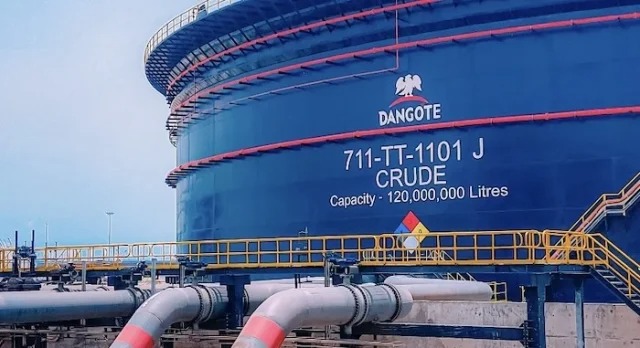
The Federal Government has said Nigeria currently lacks sufficient available crude oil to meet the Dangote Petroleum Refinery’s full requirement of 700,000 barrels per day, despite efforts to strengthen domestic refining through the naira-for-crude arrangement.
The Minister of Finance and Coordinating Minister of the Economy, Taiwo Oyedele, disclosed this on Friday during an appearance on Channels Television’s Politics Today programme.

Oyedele explained that although Nigeria produces crude oil, the volume available for allocation to the refinery remains insufficient to meet its entire daily requirement.
“But we are still not at the point where we can give Dangote 700,000 barrels. So the people that are saying we’ll discount it, we’ll do the cost of production, they don’t know what they’re talking about. We don’t have enough to service Dangote,” the minister said.
He also explained that even if Nigeria could supply the refinery with 700,000 barrels daily, the country’s crude oil would not be sufficient for all its processing needs because of differences in crude grades.
According to him, Nigerian crude is generally classified as sweet crude, while the refinery also requires imported heavier crude to optimise its operations.
“I need to say that even if we have 700,000 barrels today to give Dangote — the Nigerian crude is the sweet crude — it would not be the most optimal input for Dangote. Dangote needs to still import some heavy crude,” he said.
Oyedele stressed that the government did not currently have up to 700,000 barrels of uncommitted crude oil available to allocate to the refinery.
Naira-for-crude deal to improve supply stability
The minister said the naira-for-crude arrangement introduced by President Bola Tinubu was designed to help stabilise the domestic petroleum market, although supply constraints remained.
He said the arrangement had helped achieve some stability but acknowledged that Nigeria still needed to increase production and make more crude available before it could fully meet the refinery’s requirements.
“And it has worked, but we don’t have enough quantity to give as of yet. As we ramp up production and we free up some barrels, we’ll get to a point where we’ll be able to give Dangote everything he wants and other refiners will be able to get enough,” Oyedele said.
He expressed hope that Nigeria would eventually refine all the crude oil it produces locally and export only refined petroleum products.
Why Nigeria cannot allocate all its crude to local refineries
Oyedele also explained that Nigeria’s total crude oil production does not belong exclusively to the Federal Government, as a significant portion is allocated to companies operating under joint ventures and production-sharing contracts.
He noted that the volume produced daily should not be confused with the quantity available for the government to allocate freely.
“If you do 1.8 million barrels per day, that does not belong to Nigeria alone,” he said.
According to the minister, crude oil produced under these arrangements is divided among the parties based on agreed terms, with allocations covering production costs, royalties and the sharing of profits.
The portion used to recover production expenses is known as cost oil, while royalties are paid before the remaining profit oil is distributed among the relevant parties.
These arrangements, he explained, limit the amount of crude that the government can freely direct to domestic refineries.
Oyedele further claimed that Nigeria had almost entirely exhausted its share of crude oil as the government struggled to finance petrol subsidies before Tinubu introduced his economic reforms.
He said the Nigerian National Petroleum Company Limited (NNPC), which manages the country’s crude oil interests, had less than 100,000 barrels of free crude remaining before the reforms.
According to him, the government turned to money creation after exhausting available revenues, but the funds raised were still insufficient to meet its spending obligations.
He added that the government subsequently began using future crude oil production to secure borrowing to finance current consumption, describing the arrangement as a potential crisis.
The minister’s remarks highlight the challenges facing Nigeria’s efforts to expand domestic refining, including crude availability, contractual obligations and the cost of financing fuel consumption.
Although the government hopes to increase crude production and supply more local refineries, Oyedele’s comments indicate that meeting the Dangote refinery’s full requirements will depend on the availability of additional uncommitted crude oil.




Related posts:
 Nigeria Is Trapped in Turbulence — Kukah Raises Fresh Alarm in Easter Message
 Kuwait Suspends Visas for Nigerians Until Further Notice
 Dangote Refinery Retains Position as Europe’s Biggest Jet Fuel Supplier
 President Tinubu Postpone Return To Nigeria Again
 US Firm Urges Lenders to Suspend Fresh Loans to Nigeria Ahead of 2027 Election
 Moove Exits Nigeria After Six Years