



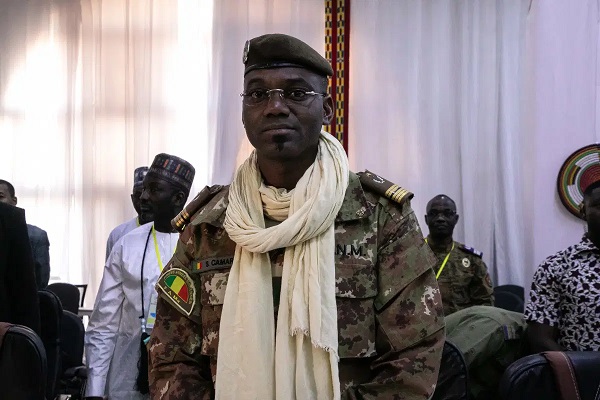
Mali’s Defence Minister, Sadio Camara, has been killed in a car bomb attack near the capital, marking a major escalation in the country’s ongoing security crisis, Conquest Magazine reports.
According to family members and military sources, the explosion occurred outside his residence in Kati, a key military hub close to Bamako. Camara was killed on Sunday, April 26, alongside at least three family members in the blast, which has been linked to militants affiliated with Al-Qaeda.

The attack was part of a broader wave of coordinated assaults launched a day earlier across multiple towns, including Kati—a stronghold of Mali’s ruling military junta and home to several top officials.
Authorities say the operations involved both jihadist fighters and separatist groups, notably the Group for the Support of Islam and Muslims (JNIM) and the Azawad Liberation Front. The scale and coordination of the attacks have placed significant pressure on the military-led government, with clashes continuing into a second day.
The killing of Camara represents one of the most high-profile attacks on Mali’s leadership in recent years, underscoring the deteriorating security situation in the Sahel region.
Mali has faced a complex insurgency since 2012, when Tuareg rebels and Islamist militants seized large areas of the country’s north following a coup. Despite the deployment of international forces, including French troops and United Nations peacekeepers, violence has persisted and spread into central and southern regions.
Following successive military coups in 2020 and 2021, the current junta has shifted alliances—scaling back cooperation with Western partners while strengthening ties with countries such as Russia and relying more heavily on domestic military operations.
Despite repeated offensives, militant groups linked to both Al-Qaeda and the so-called Islamic State continue to carry out deadly attacks on civilians, security forces, and government officials.
Analysts say the coordinated nature of the latest assaults highlights the growing capability of militant networks, as well as ongoing challenges in securing key military installations.
Investigations into the bombing are ongoing as authorities work to contain the situation and prevent further escalation.




Related posts:
 Subair named board chair of the year, as LIRS emerges top revenue agency
 Disu Inaugurates Committee on State Police Implementation
 AGF, Lateef Fagbemi Takes Over Malami, Son’s Trial Following Alleged Terrorism
 I Must Be A Part Of Your Decision To Select Your Next Supreme Leader – Trump Tells Iranians
 FG Reaffirms Commitment to Protect Nigerians in Iran, Activates Evacuation Plans