



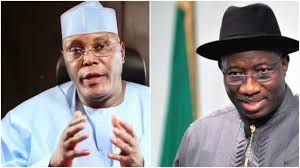
In this report for Conquest Magazine, former Nigerian President Goodluck Jonathan has pushed back against remarks made by former Vice President Atiku Abubakar, who recently questioned his leadership experience while in office.
Atiku, in a recent interview, described Jonathan as “a decent young man” but argued that his alleged inexperience contributed to challenges faced during his presidency, particularly in managing national affairs during difficult periods.

Responding on Monday, April 20, at the 2025 awards ceremony of the Association of Retired Career Ambassadors of Nigeria (ARCAN) in Abuja, Jonathan addressed the criticism without directly naming Atiku but made clear reference to the comments.
“So not too long ago, a very senior politician said Jonathan was too young and that was why he made mistakes,” he said. “If I made mistakes, yes—nobody who becomes a governor or president will say they did not make mistakes. All human beings must make mistakes.”
Jonathan questioned the basis of the “inexperience” label, noting that he assumed office in 2010 at the age of 53 and completed his tenure in 2015 at 58.
“Must it have been 100 years before I ran the affairs of the state?” he asked, dismissing the notion that age alone determines leadership capability.
Defending his administration, Jonathan pointed to key achievements, particularly in Nigeria’s foreign policy and diplomacy. He highlighted the country’s successful election to the United Nations Security Council during his tenure as evidence of effective leadership.
“If I were so naive, I don’t think I would have been able to navigate that process,” he added.
Meanwhile, Atiku—who is reportedly seeking the presidential ticket of the African Democratic Congress (ADC) ahead of the 2027 elections—also stirred debate by downplaying the national influence of other political figures, including Peter Obi, Rotimi Amaechi, and Rabiu Kwankwaso, describing their political strength as largely regional.
Jonathan, however, used the occasion to shift focus toward a broader concern, warning that political instability continues to hinder economic growth across West Africa.
“We cannot progress economically if we are very unstable societies politically,” he said.
The exchange underscores ongoing political tensions and differing perspectives as Nigeria gradually builds momentum toward the 2027 general elections.




Related posts:
 Tinubu Will Lose 2027 Election If Atiku Forms North–South Coalition Ticket – Dele Momodu
 Atiku Hires PR Firm For $1.2m To Boost Reputation
Rice, Spaghetti, and Indomie Cannot Secure Legitimacy at the Ballot Box— Atiku Tells Tinubu
 Tinubu’s Media Adviser, Bwala Defends Al Jazeera Appearance Amid Backlash
 Tinubu Says Nigeria Has Emerged From Economic Uncertainty During UK State Visit
 Zamfara Education Commissioner Resigns Amid Governor Lawal’s Defection to APC