



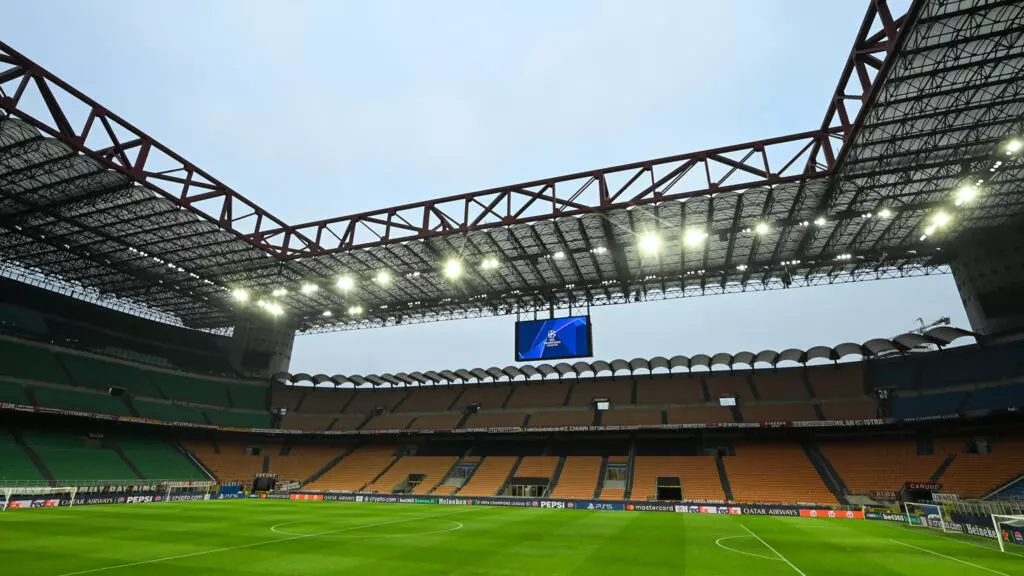
Italian football is facing a major crisis following leadership resignations and a stern warning from UEFA President Aleksander Čeferin that the country could lose its role as co-host of Euro 2032 if urgent infrastructure improvements are not made.
The situation escalated after Gabriele Gravina stepped down as president of the Italian Football Federation during an emergency council meeting. His resignation came just days after Italy failed to qualify for the FIFA World Cup for a third consecutive time, losing on penalties to Bosnia and Herzegovina. The disappointing result intensified pressure from government officials, including Sports Minister Andrea Abodi, who had called for sweeping changes in football leadership.

Shortly after Gravina’s exit, Italian football legend Gianluigi Buffon also resigned from his role, further deepening uncertainty within the system. Attention has now shifted to head coach Gennaro Gattuso, whose position appears increasingly untenable after failing to secure World Cup qualification. Gattuso had only taken over in 2025 following the departure of Luciano Spalletti.
While a new federation president is expected to be elected in June, the incoming leadership will inherit significant structural challenges—chief among them Italy’s preparedness to co-host the UEFA Euro 2032 tournament alongside Turkey.
Čeferin made it clear that hosting rights are conditional, warning that Italy risks losing its role if stadium infrastructure is not brought up to standard. He described the country’s current facilities as among the worst in Europe, underscoring the urgency of the situation.
Italy is required to select five host stadiums by October from a shortlist of 11 cities. At present, only Juventus’ Allianz Stadium fully meets UEFA requirements. Planned upgrades to iconic venues such as San Siro, Stadio Diego Armando Maradona, and Stadio Artemio Franchi—as well as proposals for a new stadium in Rome—are now under intense scrutiny, with construction deadlines fast approaching.
Beyond infrastructure concerns, Čeferin also pointed to deeper systemic issues, including longstanding tensions between football authorities and political institutions in Italy. Although Gravina had served as UEFA’s first vice-president and maintained close ties with the governing body, Čeferin stressed that the challenges facing Italian football extend far beyond any single individual.
In his final remarks, Gravina acknowledged the gravity of the situation, admitting that Italian football requires a fundamental overhaul following the latest setback.
With time running out and expectations mounting, Italy now faces a critical period that will determine not only its role in Euro 2032 but also the future direction of the sport within the country.




Related posts:
 Osimhen Sets New Champions League Record for Nigeria
 Finalissima Clash Between Spain and Argentina Cancelled
 Full List of UEFA Champions League Quarter-Final Fixtures
 Anthony Joshua Relocates to Dubai Despite Middle East Tensions
 Bryan Mbeumo Praises Calvin Bassey, Calls Super Eagles Defender a “Beast”
 CAF Officially Recognise Morocco as 2025 AFCON Champion