



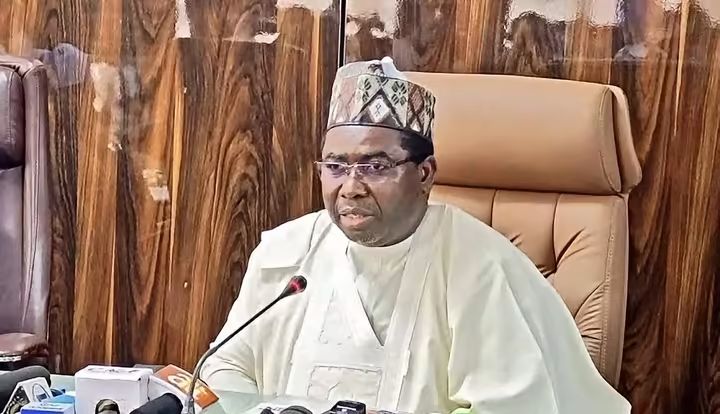
The Chairman of the Independent National Electoral Commission (INEC), Joash Amupitan, has pledged not to accept any political or diplomatic appointment after completing his tenure at the electoral body.
Amupitan made the declaration on Thursday during a panel discussion at Chatham House in London, themed ‘Nigeria’s 2027 Elections: Democratic Trajectory and Regional Stability Beyond the Ballot’.

He was responding to a question on whether he would reject political or diplomatic appointments after leaving office, particularly in light of the decision by his predecessor, Mahmood Yakubu, to accept an ambassadorial nomination from President Bola Tinubu.
In November 2025, Yakubu was among 32 ambassadorial nominees forwarded to the Senate by Tinubu for confirmation. He was subsequently designated as Nigeria’s non-career ambassador to Qatar.
Responding to the question, Amupitan said he had no intention of accepting any appointment from anyone after leaving INEC, insisting that his current position was a national assignment built on public trust.
“I’m not going to accept any appointment from anybody because coming to serve here is based on trust,” he said.
He added that he had taken an oath to remain neutral and ensure that elections conducted under his leadership were free, fair and credible.
According to him, serving as INEC chairman should not be viewed as an opportunity to secure further political appointments, noting that he had spent much of his life in public service.
“It’s a national assignment, and somebody must do this job. It’s not a job that you want to spend five years and at the end of the day you’re not going to even serve yourself.
“All my life I have served the public, so there should be occasion where you should also have time to serve yourself,” he said.
Amupitan, who is a professor of corporate governance, also made a remark about wealth creation and his prospects after leaving public office.
“Because I’m a professor of corporate governance. I know where the hidden wealths are in this world, part of which are in Nigeria. So, a lot of people are looking for it. I should also be part of it,” he added.
On the controversy surrounding the 2023 general election, the INEC chairman acknowledged that problems with result transmission and management had significantly weakened public confidence in the commission.
He identified collation centres as the major challenge in Nigeria’s election result management process, rather than polling units.
Amupitan said INEC had introduced additional safeguards to prevent inaccurate results, including figures involving over-voting, from being uploaded to its Result Viewing Portal (IReV) ahead of the 2027 elections.
“We found, for instance, that the problem of election result declaration and management in Nigeria is not even at the polling unit, it’s at the collation centres,” he said.
He explained that problems with result transmission during the 2023 elections arose partly because results could not be successfully uploaded to IReV.
According to him, the commission has since strengthened its validation process to ensure that only accurate results from polling units are uploaded to the platform.
“But now, we have devised a safeguard where if the result is not accurate at the polling unit, it will not even go to the IReV,” he said.
The INEC chairman further disclosed that the commission had reduced the maximum number of voters assigned to each Bimodal Voter Accreditation System (BVAS) device from 1,250 to 850 to improve accreditation speed.
He also said INEC was strengthening its collaboration with security agencies to improve voter safety and ensure a more credible electoral process in 2027.




Related posts:
 INEC Has No Candidate, Will Not Favour Any Party – Amupitan
 Tinubu Defends INEC, Says Opposition Is ‘Crying Wolf’ Ahead of 2027 Elections
 INEC Threatens ₦10m Fine, Jail Term as Politicians Escalate Campaign Rhetoric Ahead of 2027
 INEC Debunks Fresh Nationwide Voter Registration, Warns Nigerians Against Fake Website
NDC Gives INEC 72 Hours to Include Five Governorship Candidates in 2027 Election List
 Court Declares Okorocha Winner of Imo West APC Primary, Orders INEC to Recognise Him