



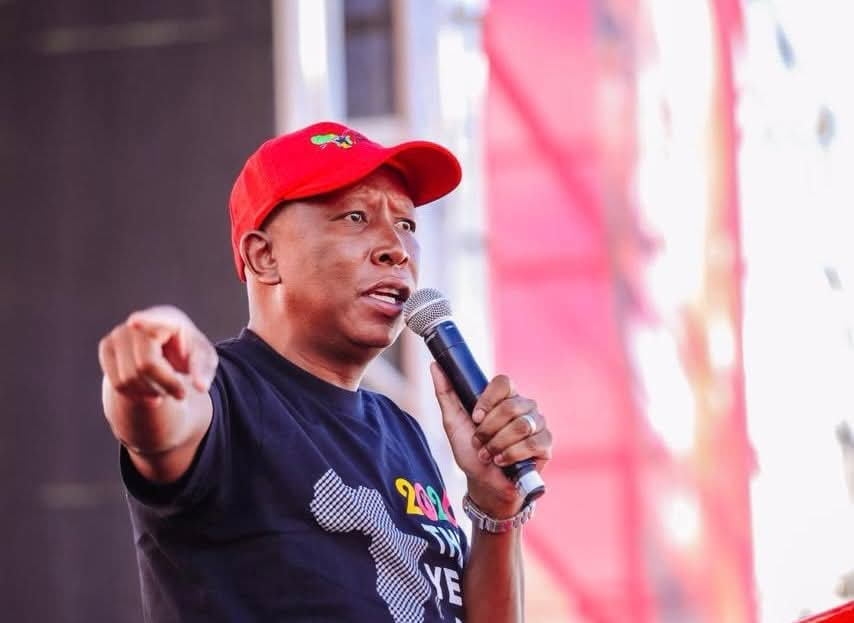
South African opposition leader Julius Malema has delivered a forceful critique of ongoing attacks against foreign nationals, describing the violence as counterproductive and harmful to the country’s economic stability.
Addressing the issue publicly, Malema questioned the rationale behind targeting migrants, particularly Africans from countries such as Nigeria, Ghana and Zimbabwe. He challenged those involved in the attacks to reflect on their actions, asking how many jobs had been created as a result of such violence.

According to him, the destruction of foreign-owned businesses often leads to deeper economic hardship, rather than relief. Many of these enterprises, he noted, employ local South Africans, meaning their closure results in job losses and reduced economic activity within already struggling communities.
Malema also took aim at what he described as misplaced blame, arguing that unemployment cannot be solved by targeting vulnerable groups. He suggested that the real issue lies in structural economic challenges and a lack of skills development, warning that scapegoating foreigners diverts attention from meaningful solutions.
Beyond economics, the politician framed his position as a moral and principled one. He rejected calls for exclusionary policies based on nationality, stating that access to basic services such as healthcare and education should not be denied to fellow Africans. In particular, he stressed that pregnant women and children, regardless of origin, deserve dignity and care.
Drawing a parallel with South Africa’s apartheid past, Malema cautioned against policies that echo historic patterns of exclusion. He insisted that his stance is guided by long-held principles rather than political expediency, adding that he would not compromise his values for electoral advantage.
His comments come at a time when debates over xenophobia, unemployment and access to economic opportunities continue to shape public discourse in South Africa, highlighting the tension between economic frustration and social cohesion.




Related posts:
 ADC Raises Alarm Over Handling of Cases Involving Malami and El-Rufai
 Annie Macaulay Speaks on Life After Marriage Crash
 EFCC Arraigns Two FSDH Merchant Bank Ltd Officials For Allegedly Stealing ₦527 Million Via SWIFT Transfers
 Stop Shunning Our Recruitment Exercises — Nigerian Army begs South East Youths