



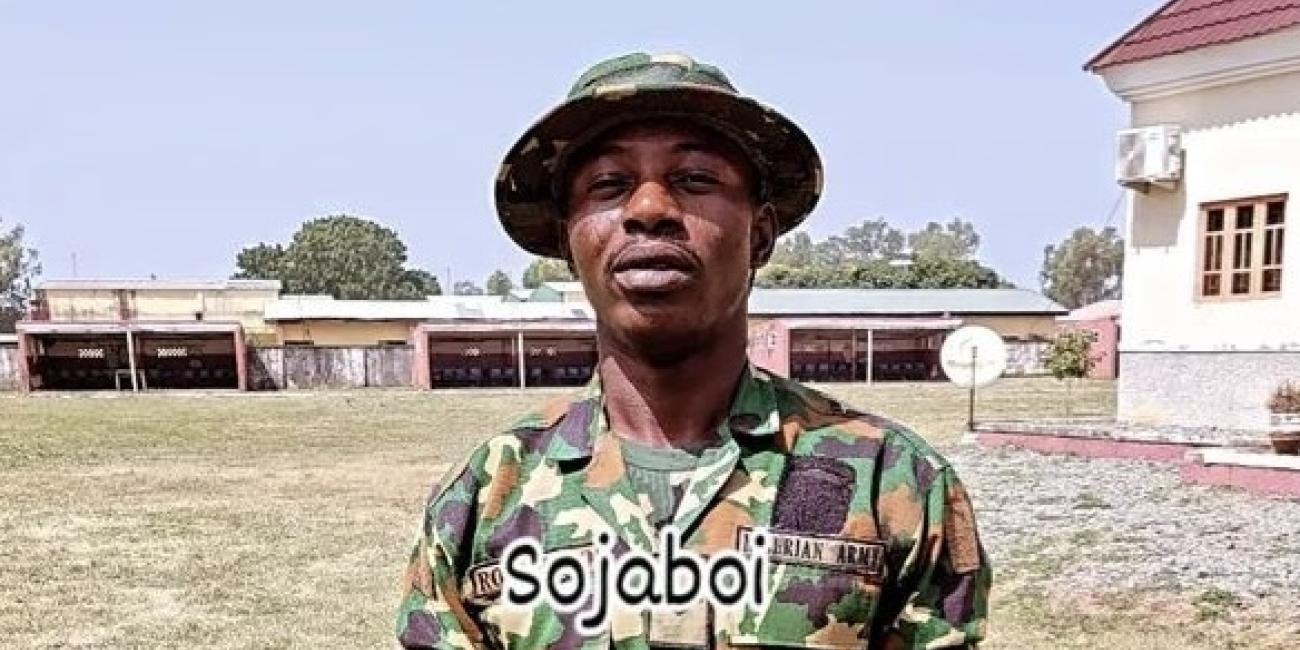
A former soldier of the Nigerian Army, Rotimi Olamilekan popularly known as Soja Boi has reignited debate over military welfare after publicly challenging the Army to release its payroll records.
His latest remarks come hours after the Army dismissed his earlier allegations about poor pay and inadequate equipment as “false and misleading.”

In a video shared on Tuesday, Olamilekan clarified that his intention was not to discredit the military but to shed light on realities faced by rank-and-file soldiers.
“I am not trying to spoil the Nigerian Army’s image… I am just speaking the facts and I will be backing them with evidence,” he said.
To support his claims, he displayed bank transaction alerts he said were payments received during his time in service.
According to Olamilekan, the alerts showed:
- ₦112,061.59 — which he identified as his monthly salary
- ₦20,000 — described as a “grumbling allowance”
- ₦45,000 — an operational allowance for soldiers deployed to conflict zones such as Maiduguri
He also mentioned an additional ₦6,000 security allowance, noting that some payments depend on deployment status.
“If you are not in operation, they don’t pay you that one,” he explained.
He added that soldiers stationed in barracks typically receive only their base salary and the smaller allowance.
Beyond pay, Olamilekan repeated a controversial claim: that soldiers often purchase their own protective gear.
“Helmet, you go buy. Fragmentation jacket, you go buy them,” he alleged.
He urged Nigerians with relatives in the military to independently verify his statements.
In response, the Nigerian Army, through its Acting Director of Public Relations, Appolonia Anaele, rejected the claims.
The Army maintained that all personnel are properly equipped through official logistics systems and are not deployed to operational areas without adequate protection.
It acknowledged that some soldiers may choose to supplement issued kits, but described such actions as voluntary rather than necessary.
On remuneration, the Army stated that soldiers receive structured monthly salaries along with various allowances, all paid directly into their accounts.
While Olamilekan’s claims have gained attention, the transaction alerts he presented have not been independently verified. Additionally, some of the payment descriptions do not clearly identify the Nigerian Army or any government body as the source.
Olamilekan first came into the spotlight in February 2026 after a viral video in which he urged political leaders to send their children into military service.
He was later arrested, spent time in detention, and eventually dismissed from the Army.
According to the military, his dismissal was due to repeated acts of indiscipline, including violations of social media policy and unauthorized media appearances—not the content of his public criticisms.
The controversy has sparked wider conversations about transparency, military welfare, and the realities faced by soldiers on the ground.
With Olamilekan now openly challenging the Army to publish its payroll, the issue is likely to remain in the public spotlight—raising difficult questions about accountability and trust within one of Nigeria’s most critical institutions.




Related posts:
 Subair named board chair of the year, as LIRS emerges top revenue agency
 Disu Inaugurates Committee on State Police Implementation
 AGF, Lateef Fagbemi Takes Over Malami, Son’s Trial Following Alleged Terrorism
 I Must Be A Part Of Your Decision To Select Your Next Supreme Leader – Trump Tells Iranians
 FG Reaffirms Commitment to Protect Nigerians in Iran, Activates Evacuation Plans