



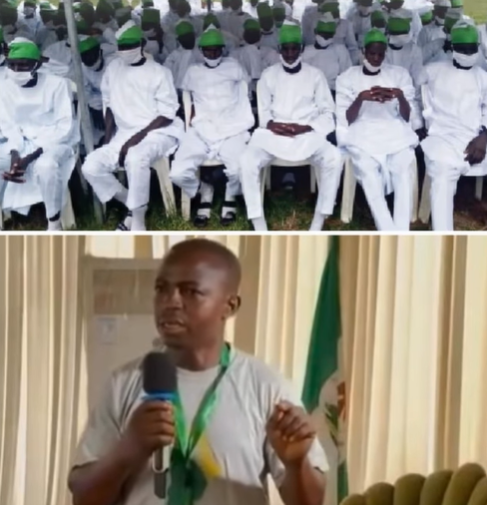
Claims have surfaced alleging that former members of Boko Haram are receiving financial compensation and monthly stipends after undergoing government-backed rehabilitation programmes — a development that has reignited debate over Nigeria’s counterinsurgency strategy.
The allegations were made by Enoch Yohanna, an indigene of Borno State, who spoke at a recent public event, expressing deep frustration over what he described as the use of taxpayer funds to reintegrate individuals accused of severe violence and mass atrocities.

“My pain is that the assailants who killed my father and carried out mass abductions are being paid with taxpayers’ money,” Yohanna said.
According to Conquest Magazine, the claims centre on the federal government’s rehabilitation framework known as Operation Safe Corridor, launched in 2016 under the administration of former President Muhammadu Buhari. The programme is designed to provide a structured exit pathway for “low-risk” and “repentant” fighters through deradicalisation, rehabilitation, and reintegration (DRR) processes.
Yohanna alleged that participants in the programme undergo assessments based on their past involvement in insurgent activities, including the number of killings attributed to them, before being assigned different durations of rehabilitation. He further claimed that after completion, some individuals receive financial support reportedly including lump-sum payments and monthly stipends.
He stated: “These are the people that are given payoff of ₦3 million and monthly salary of ₦50,000… after being rehabilitated and cannot live without using guns, the government will provide gun for you as a civilian JTF.”
These assertions also referenced the existence of civilian auxiliary security groups, often referred to as civilian joint task forces, which have been used in various northern states including Zamfara State to support local security operations.
Yohanna further alleged that some rehabilitated individuals are deployed beyond Nigeria’s borders for labour-related activities, claims which have not been independently verified by Conquest Magazine or confirmed by federal authorities.
The federal government has previously defended rehabilitation and reintegration initiatives under Operation Safe Corridor, arguing that they are aimed at reducing insurgent recruitment, encouraging defections, and improving long-term security stability in the northeast region. Security analysts have also noted that deradicalisation programmes are commonly used in post-conflict environments globally, though they remain controversial, particularly among communities directly affected by insurgent violence.
The allegations have sparked renewed public debate over accountability, justice for victims, and the effectiveness of reintegration policies in regions long affected by insurgency.
As discussions continue, Conquest Magazine understands that the issue reflects a broader tension between national security strategy and the lived experiences of communities still recovering from years of conflict in Nigeria’s northeast.




Related posts:
 Borno Reports 75% Success in Reintegration of Former Insurgents
 40 Nigerian Soldiers, Lieutenant Colonel Killed in Boko Haram Attacks on Borno Military Bases
 Tragedy As Boko Haram Attack Borno Community
 Troops Arrest Suspected Boko Haram/ISWAP Member Attempting to Enter Maiduguri
 Nigerian Military Debunks Claim of Recruiting Ex-Boko Haram Fighters
 Police Reportedly Arrest Sender of Gun That Led to Killing of Delta Youth by a Police