



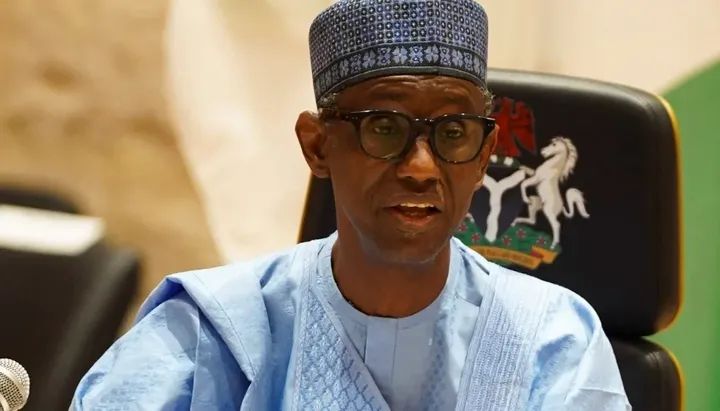
Nigeria’s National Security Adviser, Nuhu Ribadu, and the African Union Counter-Terrorism Centre have warned that terrorist groups are increasingly using social media, cryptocurrencies and emerging technologies to recruit members, finance operations and coordinate attacks across West Africa and the Sahel.
They raised the concern in Abuja on Tuesday during a three-day regional training conference focused on detecting and disrupting terrorists’ exploitation of information and communication technologies and emerging technologies.

Ribadu, who was represented by the National Coordinator of the National Counter Terrorism Centre, Maj Gen Adamu Laka, said terrorist groups were taking advantage of digital platforms to spread propaganda, radicalise potential recruits, raise funds and coordinate cross-border operations.
He warned that advances in artificial intelligence, drone technology and virtual assets had introduced new challenges for Nigeria and other countries battling insecurity in the region.
“Emerging technologies add further complexity: Artificial Intelligence can rapidly produce personalised content; drones and autonomous systems can expand operational capabilities; and virtual assets can create new financing channels. We must, therefore, strengthen our ability to anticipate, detect, analyse and disrupt threats before they materialise,” he said.
The NSA stressed that tackling the growing threat would require more than the acquisition of sophisticated equipment, calling for greater technical expertise, stronger institutions and improved cooperation among security agencies.
He also urged countries across West Africa and the Sahel to strengthen cross-border intelligence sharing and ensure the timely exchange of actionable information on cyber threats.
“Nigeria recognises that no institution, country or sector can defeat terrorism alone,” Ribadu said.
He disclosed that Nigeria was working with the African Union Counter-Terrorism Centre to secure regional accreditation for the National Counter Terrorism Centre as a centre of excellence for counterterrorism in West Africa and the Sahel.
According to him, the initiative followed President Bola Tinubu’s declaration at the High-Level Africa Counterterrorism Summit held in April 2024.
ISWAP, Boko Haram Exploit Digital Platforms — AU
Also speaking at the conference, the Acting Director of the African Union Counter-Terrorism Centre, Idriss Lalalli, said terrorist organisations, including the Islamic State West Africa Province (ISWAP), Boko Haram and Jama’at Nusrat al-Islam wal-Muslimin (JNIM), were expanding their activities through digital technologies.
He said the groups were exploiting social media for recruitment, using mobile money, gift cards and cryptocurrencies to move funds, and turning to encrypted communications and other technologies to support their operations.
“Across West Africa and the Sahel today, ISWAP, Boko Haram and JNIM are extending their reach through technology. They recruit on social media platforms, move and conceal funds via mobile money, gift cards and cryptocurrencies,” Lalalli said.
He added that the groups were also using darknet marketplaces to purchase weapons, satellite communications to operate beyond the reach of some monitoring systems, and drones to extend their operational capabilities across borders.
According to him, artificial intelligence was further enabling terrorist groups to tailor propaganda to different audiences and make detection more difficult.
Lalalli warned that the relative affordability and speed of digital tools had made it possible for small terrorist cells to reach audiences far beyond their immediate locations and adapt more quickly than security agencies could respond.
“What makes this difficult is speed and cost. A cell with a modest budget can now reach audiences far beyond its physical presence and move faster than our procedures can respond. The capability to counter it remains thinly and unevenly distributed across our member states,” he said.
He, however, expressed confidence that the capacity gap could be reduced through specialised training, stronger regional coordination and closer collaboration with private-sector operators.
AU Pushes Cyber Intelligence, Digital Forensics Training.
Lalalli said the training programme was designed to equip participants with practical skills in cyber threat intelligence, open-source intelligence, digital forensics and blockchain analysis.
The skills, he explained, would help security personnel identify online recruitment networks, preserve digital evidence and trace cryptocurrency transactions linked to suspected terrorist financing.
He emphasised the need to integrate the different areas of expertise to strengthen investigations and support successful prosecutions.
The AU official also called for closer partnerships with social media companies, telecommunications operators and financial service providers, noting that much of the digital infrastructure exploited by terrorist groups was owned and operated by private organisations.
Addressing the participants, Lalalli urged them to apply the knowledge gained during the programme and share their expertise with other security personnel across the continent.
“You leave as this continent’s first cohort of trainers in this domain. You will leave here not just carrying home a certificate, but a responsibility. The Centre will stand behind you. But the multiplier is you,” he said.
The three-day conference brought together participants from West Africa and the Sahel, as well as representatives of the African Union, the Economic Community of West African States (ECOWAS), the Multinational Joint Task Force, regional intelligence structures and international organisations.
The gathering is expected to strengthen regional capacity to detect and disrupt the growing use of digital technologies by terrorist groups operating across the region.




Related posts:
 Government Knows Identities Of Terrorist Financiers – Ex Army Chief Buratai
 Terrorist Attack Military Base in Borno, Kills Army General, Soldiers
 FG Launches AI-Powered Education Data Platform to Track Nigerian Students
 Reps Summons Ribadu, Service Chiefs Over Raising Insecurity, School Abductions
 UN Warns of Terrorists Exploiting Emerging Technology in Nigeria
 Osun Poll: Adeleke’s Camp Urges Ribadu, Police to Enforce Tinubu’s Directive