



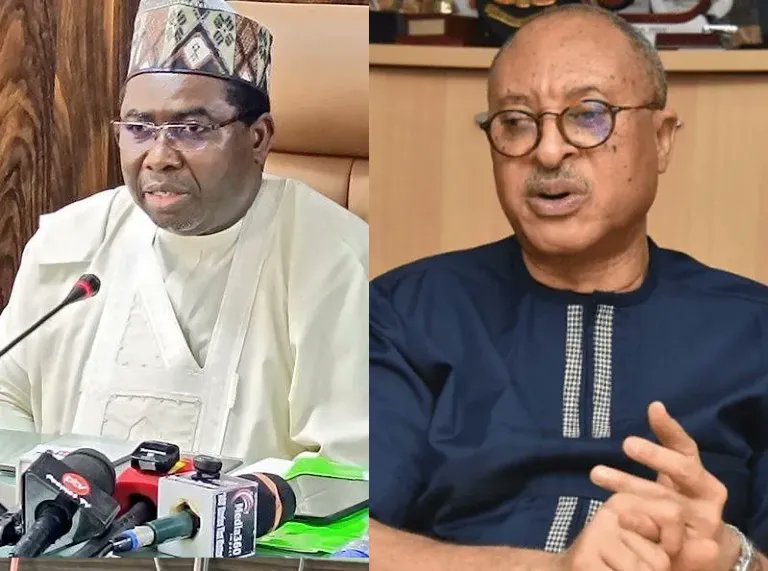
Prominent political economist Pat Utomi has called on the Nigerian Bar Association (NBA) to step into what he describes as a deepening institutional crisis involving the Independent National Electoral Commission (INEC).
In a series of posts shared on X, Utomi raised concerns about the direction of Nigeria’s democratic institutions, urging influential voices across society to speak up.

Utomi specifically appealed to religious leaders, traditional rulers, and senior legal professionals to break their silence, warning that inaction in the face of perceived injustice could have lasting consequences.
At the center of his demand is a call for the NBA to persuade Joash Amupitan to step down as INEC chairman.
He cautioned that failure to act decisively could result in what he described as a “free fall” of Nigeria’s institutional and moral systems.
In a striking comparison, Utomi likened the current leadership of INEC to Joseph Stalin, referencing the authoritarian legacy of the Soviet-era ruler.
He suggested that recent developments within the electoral body reflect troubling tendencies that could undermine democratic principles.
Utomi also used religious references, including the resurrection of Jesus Christ, to underscore his concerns about morality within public institutions.
He criticized what he described as the growing influence of money within the legal profession and judiciary, arguing that it has contributed to actions that weaken electoral laws and the rule of law.
He warned that those who remain silent despite recognising these issues—including religious and traditional leaders—would ultimately be held accountable.
Utomi’s comments appear to be linked to INEC’s recent decision to derecognise factions of the African Democratic Congress (ADC), led by David Mark and Nafiu Bala.
INEC stated that its decision was based on its interpretation of a Court of Appeal ruling concerning the party’s internal leadership crisis.
However, the faction led by Mark has rejected the commission’s stance, accusing INEC of acting under external influence.
The development has sparked widespread debate over whether INEC correctly interpreted the court’s judgment, leaving the ADC in a state of uncertainty with no leadership currently recognised by the electoral body.
As tensions rise, Utomi’s intervention highlights broader concerns about transparency, accountability, and the independence of key democratic institutions in Nigeria.
Whether his call will prompt action from the NBA or other stakeholders remains to be seen—but the issue has undoubtedly added to ongoing conversations about the future of governance and the rule of law in the country.




Related posts:
 INEC Shifts Deadline for Party Membership Registers Ahead of 2027 Polls
 Lets Give Them A Second Chance – Defence Chief Calls for Rehabilitation of Repentant Terrorists
 Sky Turns Red in Western Australia as Cyclone Approaches
 Controversy Trails OPM’s Pastor Chibuzor’s Claim on Autistic Son’s Behavior After Marriage
 Nigerian National Arrested in India Over Alleged N290 Million Drug Operation
 Amercian Politician Found Dead in Her Apartment, Husband Arrested