




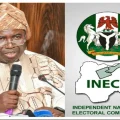
Protesters on Thursday confronted the Chairman of the Independent National Electoral Commission (INEC), Prof. Joash Ojo Amupitan, outside Chatham House in London, accusing him and the electoral body of alleged bias and electoral irregularities.
The demonstrators surrounded a vehicle conveying Amupitan as he left the venue, shouting accusations against the commission and demanding his resignation.

Amupitan was in London to participate in a panel discussion organised by Chatham House in collaboration with the Kimpact Development Initiative on Nigeria’s preparations for the 2027 general elections.
The protest was reportedly organised by Nigerian diaspora activists who mobilised through social media before gathering outside the event venue.
During the demonstration, the protesters described INEC as a “criminal organisation” and accused Amupitan of favouring President Bola Tinubu and the ruling All Progressives Congress (APC).
They also called for his resignation over alleged irregularities in the preliminary voters’ register, including duplicate entries, the use of artificial intelligence-generated images and claims of fictitious polling units.
The allegations followed concerns raised over the integrity of the voters’ register ahead of the 2027 general elections.
Before Amupitan’s London visit, INEC announced that it had removed 1.6 million invalid records from the preliminary register, including entries containing manipulated AI-generated images.
The commission also disclosed that 54 officials across 10 states had been flagged in connection with the irregularities.
Despite the protest, Amupitan proceeded with his engagement at Chatham House, where he addressed concerns surrounding the credibility of future elections and public confidence in the electoral body.
During the discussion, he pledged not to accept any political or diplomatic appointment after completing his tenure as INEC chairman, saying such a decision would demonstrate his commitment to impartiality.
He also disclosed that the commission was introducing additional technical safeguards to prevent inaccurate election results from being uploaded to its Result Viewing Portal (IReV) during the 2027 general elections.




Related posts:
 INEC Chairman Amupitan Seeks Direct Federation Account Funding to Strengthen Autonomy
 Kelly Hansome: Flavour Couldn’t Sell Out London Show Because Yoruba Fans Didn’t Support Him
 EFCC Declares Lagos Woman Wanted Over Alleged Fraud
 Family Alleges ‘Mistaken Killing’ of NYSC Member by Soldiers in Abuja
 Panel Reveals Cause of Death of 37 Miners in NSCDC Custody
 INEC Investigates Suspected AI-Generated Photos in Voter Register