



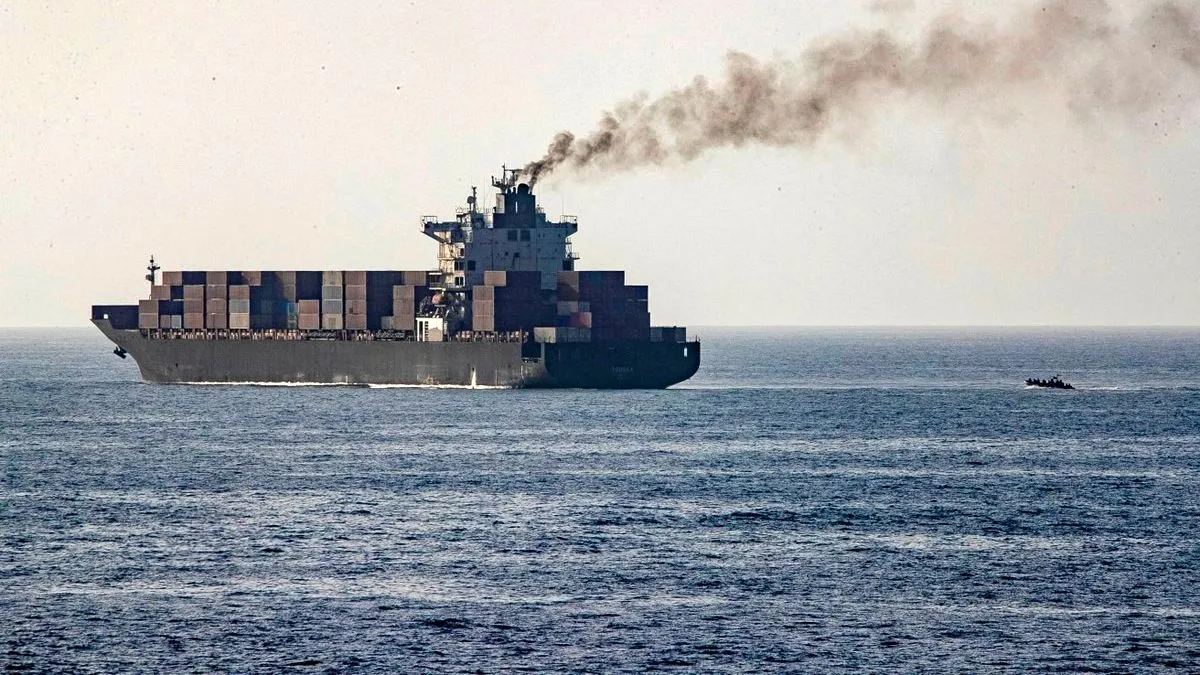
A fresh security incident in one of the world’s most strategically vital waterways has once again drawn global attention to the fragile state of Middle Eastern geopolitics. According to the United Kingdom Maritime Trade Operations (UKMTO), a container ship navigating the Strait of Hormuz was attacked earlier today by an Iranian gunboat, raising concerns about maritime safety and the stability of an already volatile region.
The UKMTO reported that the vessel was approached by a boat linked to Iran’s Revolutionary Guard, which proceeded to open fire. The assault reportedly caused significant damage to the ship’s bridge, though no casualties were recorded among the crew. Authorities also confirmed that there was no fire outbreak or environmental damage resulting from the incident.

Iranian state-linked media outlet Nour News offered a different framing of the event, stating that the ship had ignored prior warnings from Iranian forces. According to their account, the military response was a direct consequence of the vessel’s failure to comply, resulting in what they described as “extensive damage.”
While the facts surrounding the confrontation continue to be scrutinized, the timing of the incident is particularly significant. It comes amid an already delicate ceasefire arrangement involving the United States, Iran, and Israel. U.S. President Donald Trump recently announced an extension of a temporary ceasefire with Tehran, citing internal divisions within Iran’s leadership as a key factor.
Trump indicated that the ceasefire, initially set to expire this week, would remain in place until Iran presents a “unified proposal” aimed at ending hostilities with both the United States and Israel. His remarks suggest that diplomatic efforts remain ongoing, but also underscore the uncertainty surrounding Iran’s political cohesion and negotiating position.
The Strait of Hormuz, a narrow passage through which a significant portion of the world’s oil supply flows, has long been a flashpoint for geopolitical tensions. Any disruption in this corridor carries global implications, particularly for energy markets and international trade.
This latest incident raises pressing questions about the durability of the current ceasefire and whether isolated confrontations could spiral into broader conflict. It also highlights the persistent risks faced by commercial shipping in contested waters, where military presence and political tensions often intersect.
At Conquest Magazine, this development is viewed as part of a larger pattern of instability—one where diplomacy and confrontation exist side by side. As global powers navigate this uncertain terrain, the need for clear communication, restraint, and credible negotiation has rarely been more urgent.
For now, the situation remains fluid. But as history has shown, even limited engagements in the Strait of Hormuz can have far-reaching con




Related posts:
 I Must Be A Part Of Your Decision To Select Your Next Supreme Leader – Trump Tells Iranians
Trump Says War With Iran Could End Soon as Fighting Intensifies
 Iran Warns Trump to ‘Be Careful’ Amid Escalating War of Words
 Trump Criticises UK Response to Iran Conflict, Urges Greater Support in Strait of Hormuz
 Trump Claims ‘Regime Change’ in Iran Following US-Israel Strikes
 Israel Backs Trump’s Iran Ceasefire Move, Excludes Lebanon From Truce